

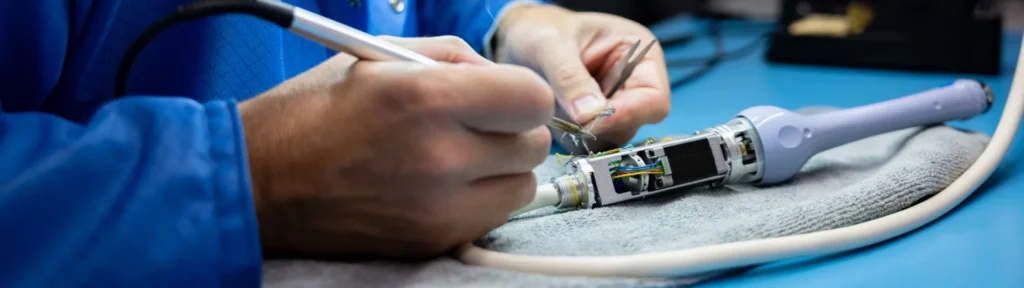
Ultrasound probes and endoscopic equipment are precision medical devices that can be costly to replace. Cable damage, connector faults, image artefacts, fluid ingress, worn insertion tubes and optical problems may develop gradually or appear after a single incident. In many cases, a professional repair assessment can determine whether the device can be restored safely and economically.
Medical Equipments Australia provides ultrasound and endoscopic probe repair services in Australia, with repairability depending on the type of fault, condition of the device and availability of suitable parts.
Why Probe Damage Should Be Assessed Early
Minor defects can become larger problems if the equipment continues to be used without assessment. A small cable split may expose internal conductors, a damaged acoustic lens can affect ultrasound image quality, and a leaking endoscope may allow fluid to enter internal components.
Early inspection helps identify whether the problem is localised and repairable before further damage develops. For hospitals, clinics, diagnostic centres and biomedical teams, this can also reduce avoidable downtime and help with equipment planning.
Common Signs an Ultrasound Probe May Need Repair
Ultrasound transducers contain delicate acoustic elements, wiring, shielding, lenses and connectors. Common warning signs include:
- Black lines or missing sections in the ultrasound image
- Intermittent image dropout when the cable is moved
- Reduced image clarity or sensitivity
- Cracks or cuts in the probe cable
- Damage to the probe housing or acoustic lens
- Bent, damaged or unreliable connector pins
- Visible wear around strain-relief areas
- Unexpected noise, artefacts or unstable signal
These symptoms do not always mean the entire probe must be replaced. Diagnostic testing can help identify whether the fault is isolated to a cable, connector, lens, internal element or another component.
Common Endoscope and Endoscopic Probe Faults
Flexible and rigid endoscopic devices are exposed to repeated handling, cleaning, disinfection and mechanical movement. Depending on the device, typical repair issues can include:
- Damaged insertion tubes
- Poor or uneven light transmission
- Distal lens damage
- Fibre-optic bundle damage
- Angulation or control problems
- Leakage or sealing faults
- Cable or connector damage
- Reduced image clarity
Because fluid ingress can cause significant internal damage, leak-related faults should be assessed promptly. Repair options vary according to the model, severity of damage and component availability.
What Happens During a Professional Repair Assessment?
A structured repair process normally begins with inspection and fault diagnosis. At Medical Equipments Australia, the process may include the following steps depending on the equipment and reported problem:
- Initial inspection: checking for visible cable, housing, connector, lens or insertion-tube damage.
- Diagnostic testing: assessing image, signal, optical or electrical performance as appropriate.
- Repair quotation: identifying the proposed work, parts and labour before repair proceeds.
- Component repair or replacement: repairing suitable faults where parts and technical options are available.
- Performance testing: checking the repaired device using testing appropriate to the completed work.
- Final quality control: confirming the device is ready for return following the repair process.
Ultrasound Probe Repair vs Replacement
The right decision depends on the age, condition, clinical use, replacement cost and extent of damage. Repair may be practical where the main assembly remains serviceable and the fault is limited to a repairable component.
Replacement may be more appropriate where damage is extensive, critical internal components are unavailable, the probe has multiple major faults, or the cost of repair approaches the cost of a suitable replacement.
If you are also comparing new, refurbished and replacement transducers, see our Ultrasound Probe Buying Guide Australia for compatibility and condition considerations, then browse the Ultrasound Probes & Equipment category for available replacement options.
What Types of Ultrasound Probes Can Be Assessed?
Depending on the model and fault, repair assessment may be available for a range of probe types, including:
- Linear array probes
- Convex and curved array probes
- Phased array and cardiac probes
- 2D, 3D and 4D probes
- Transvaginal probes
- Transrectal probes
Brand and model compatibility should always be confirmed before work is approved.
What Types of Endoscopic Equipment Can Be Assessed?
Repair enquiries may include flexible and rigid endoscopic devices such as gastroscopes, colonoscopes, bronchoscopes and cystoscopes, subject to model, fault type and parts availability. Common work may involve optical components, insertion tubes, light guides, angulation mechanisms, sealing and related assemblies. Related replacement equipment can be browsed under Endoscopic Probes & Equipment and Video Colonoscopes.
Brands Commonly Supported
Repair support may be available for equipment from major manufacturers including Philips, GE Healthcare, Siemens, Mindray, Olympus, Fujifilm and Pentax Medical. The exact repair scope depends on the specific device and fault.
How to Reduce Probe and Endoscope Damage
Good handling and storage practices can reduce preventable failures. Healthcare and biomedical teams should follow manufacturer instructions for use, cleaning and reprocessing. Practical precautions include:
- Avoid tightly bending or twisting probe cables.
- Do not allow heavy equipment to rest on cables or connectors.
- Store probes in suitable holders when not in use.
- Inspect housings, lenses, insertion tubes and connectors regularly.
- Use only cleaning and disinfection methods approved for the specific device.
- Avoid impacts, drops and unnecessary pressure on distal tips or acoustic lenses.
- Remove equipment from service when damage could affect safety or performance and arrange assessment.
Australia-Wide Repair Enquiries
Medical Equipments Australia accepts repair enquiries from hospitals, clinics, diagnostic centres and healthcare facilities across Australia, including regional and remote locations. Secure packing is important when sending sensitive probes and endoscopic equipment for assessment.
For current repair support, submit your details through our dedicated Ultrasound and Endoscopic Probe Repair Australia page. You can include the brand, model, fault description and any visible damage so the team can advise on the next steps.
Frequently Asked Questions
Can a damaged ultrasound probe cable be repaired?
Some cable and strain-relief faults may be repairable, depending on the location and extent of the damage. The probe should be inspected before a repair recommendation is made.
Can an ultrasound probe with black lines on the image be repaired?
Black lines can indicate element, cable, connector or other signal-path problems. Diagnostic testing is required to determine the cause and whether repair is practical.
Can a leaking endoscope be repaired?
Some leak and sealing faults can be repaired, but continued use or reprocessing of a leaking device can worsen internal damage. The device should be assessed promptly.
How long does probe repair take?
Turnaround depends on the fault, repair scope, model and parts availability. Timing guidance can be provided after assessment.
Is repair always cheaper than replacement?
No. Repair can be cost-effective when the fault is localised and the main device remains serviceable, but replacement may be more practical for severe or multiple faults. A quotation after inspection helps compare the options.
Request a Repair Assessment
If your ultrasound probe or endoscopic equipment is showing signs of damage or reduced performance, request an assessment before the fault becomes more extensive. Visit our probe repair service page or contact Medical Equipments Australia to discuss the equipment, model and issue.
Browse more practical purchasing and compatibility resources in MEA’s Medical Equipment Buying Guides Australia.
Related MEA resources
For repair support, visit our Ultrasound and Endoscopic Probe Repair page, browse Ultrasound Probes & Equipment, or return to the Medical Equipment Buying Guides hub.
For replacement or compatible equipment, browse ultrasound probes and equipment and endoscopic probes and equipment available through Medical Equipments Australia.