

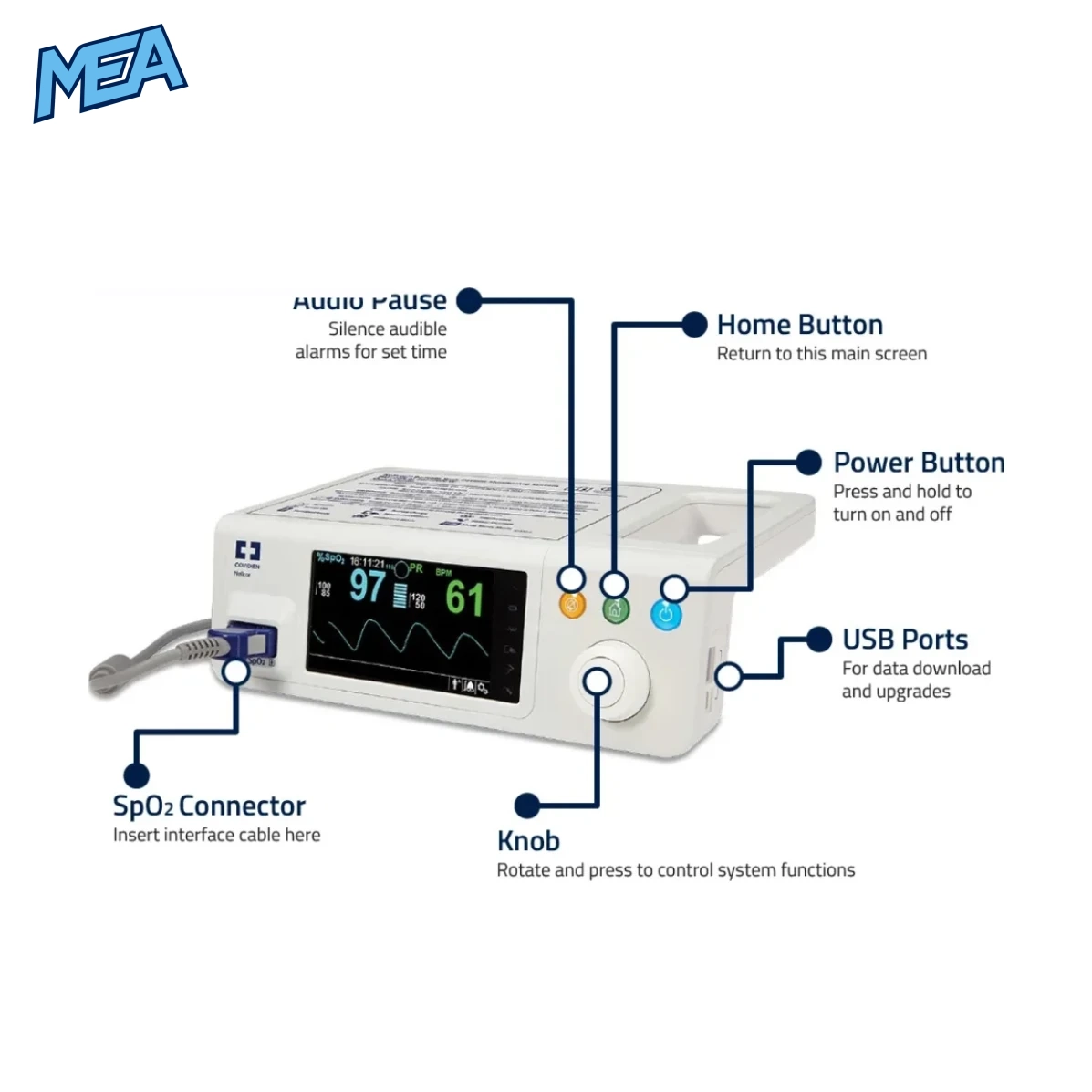
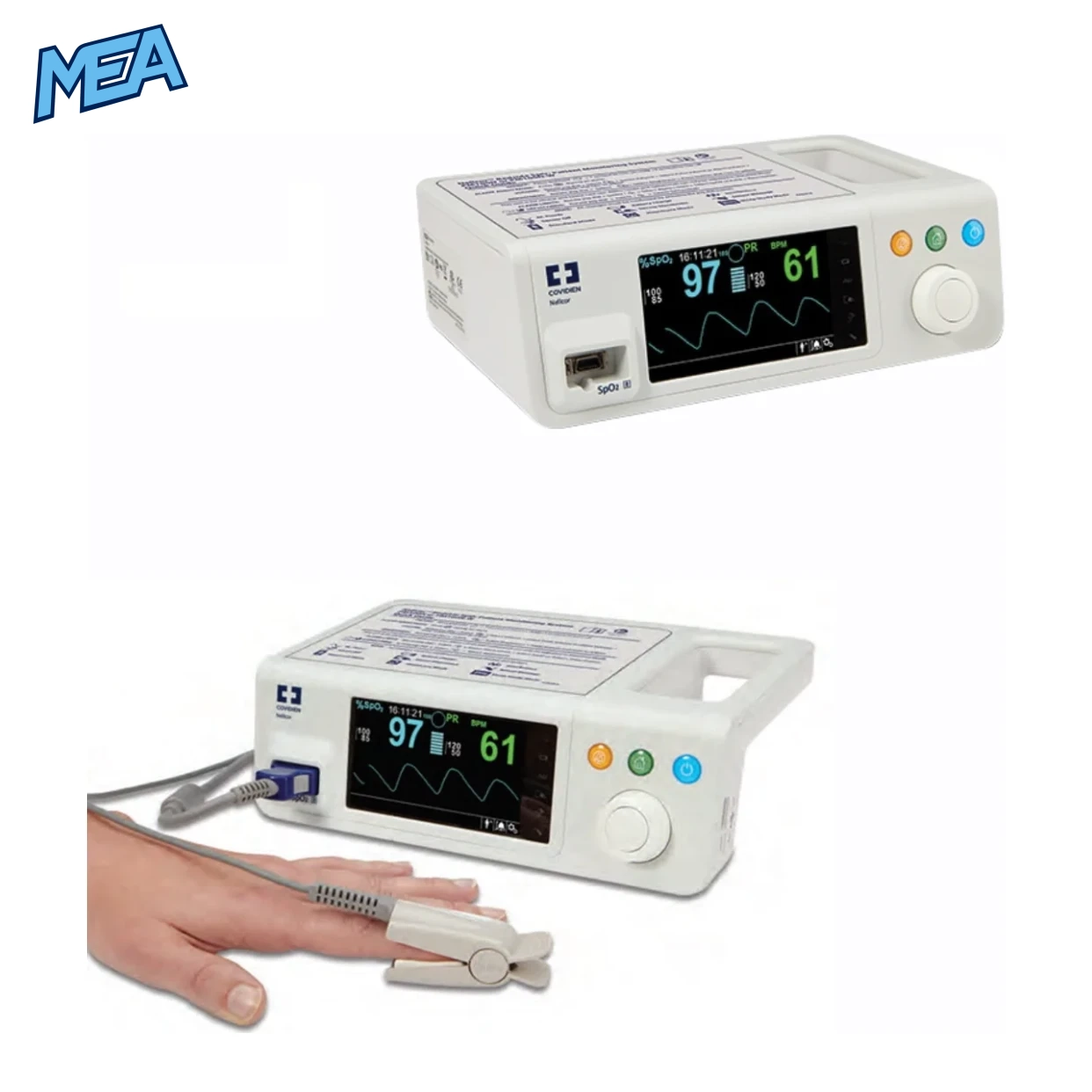



The Medtronic Nellcor™ PM100N Bedside SpO₂ Patient Monitoring System is a professional-grade pulse oximetry monitoring device designed for continuous measurement of oxygen saturation (SpO₂) and pulse rate in adult, pediatric, and neonatal patients.
Featuring advanced OxiMax™ digital signal processing technology, motion-tolerant performance, SatSeconds™ alarm management, and multiple monitoring modes, the PM100N delivers reliable clinical data in hospitals, homecare environments, sleep study facilities, and patient transport settings.
Advanced Bedside SpO₂ Monitoring for Accurate Clinical Assessment
Healthcare professionals require dependable patient monitoring systems capable of delivering accurate oxygen saturation measurements under challenging clinical conditions. The Nellcor PM100N Bedside SpO₂ Monitor is engineered to provide continuous monitoring even during patient movement, low perfusion states, and signal interference.
Built with Medtronic’s proven pulse oximetry technology, this bedside monitor enables clinicians to detect respiratory deterioration earlier, improve patient safety, and make timely treatment decisions.
The compact and portable design makes it suitable for various healthcare environments including:
- Hospitals
- Clinics
- Emergency departments
- Ambulatory care centres
- Home healthcare
- Sleep laboratories
- Long-term care facilities
- Patient transport applications
Why Choose the Medtronic Nellcor PM100N Bedside SpO₂ Monitor?
Modern healthcare environments demand more than basic pulse oximetry. The PM100N combines advanced signal processing, intelligent alarm management, and user-friendly operation into a single monitoring platform.
Key Benefits
Reliable Monitoring During Motion
Many conventional pulse oximeters struggle to provide accurate readings when patients move. The Nellcor PM100N utilises sophisticated digital signal processing algorithms that help maintain reliable SpO₂ measurements during motion and signal disturbances.
Enhanced Performance in Low Perfusion Conditions
Patients with weak peripheral circulation can present challenges for standard monitoring systems. OxiMax™ technology helps clinicians obtain dependable oxygen saturation readings even when perfusion levels are low.
Earlier Detection of Respiratory Complications
Continuous oxygen saturation and pulse rate monitoring allows healthcare professionals to identify potential respiratory deterioration before serious complications develop.
Intelligent Alarm Management
SatSeconds™ alarm technology minimises nuisance alarms by evaluating both the severity and duration of oxygen desaturation events, helping clinicians focus on clinically meaningful alarms.
Multi-Environment Flexibility
The PM100N supports:
- Hospital monitoring
- Homecare monitoring
- Sleep studies
- Patient transport monitoring
This flexibility allows facilities to use a single monitoring solution across multiple clinical applications.
OxiMax™ Technology for Superior Pulse Oximetry Performance
What Is OxiMax™ Technology?
OxiMax™ technology represents Medtronic’s advanced pulse oximetry platform designed to improve measurement reliability in difficult monitoring situations.
The technology continuously analyses signal quality and patient physiological data to deliver more dependable measurements than traditional pulse oximetry systems.
OxiMax™ Advantages
- Enhanced signal processing
- Improved low perfusion performance
- Motion-tolerant monitoring
- Faster identification of changing oxygen saturation levels
- Improved clinical confidence
This advanced platform helps ensure accurate patient assessment across diverse care settings.
SatSeconds™ Alarm Management Technology
Smarter Alarm Notifications
Traditional pulse oximeters can generate excessive alarms from brief and clinically insignificant oxygen saturation fluctuations.
The PM100N incorporates SatSeconds™ alarm management, which evaluates:
- Magnitude of desaturation
- Duration of desaturation
- Clinical significance of the event
By considering both severity and duration, the monitor can differentiate transient events from true patient deterioration.
Benefits of SatSeconds™
- Reduced alarm fatigue
- Improved workflow efficiency
- Better patient comfort
- Enhanced clinician attention to critical events
- Reduced unnecessary interventions
Designed for Hospital, Homecare, and Sleep Study Applications
Standard Hospital Mode
The standard operating mode supports:
- Bedside monitoring
- Hospital wards
- Intensive care environments
- Emergency care settings
- Intra-hospital patient transport
Homecare Mode
The PM100N meets IEC 60601-1-11 requirements for home healthcare equipment, enabling safe use outside traditional clinical environments.
Homecare mode provides:
- Simplified operation
- Caregiver-friendly monitoring
- Safe home-based patient assessment
- Reduced complexity
Sleep Study Mode
Sleep laboratories require minimal patient disturbance.
The PM100N Sleep Study Mode includes:
- Dimmed display brightness
- Muted alarms
- Reduced patient disruption
- Enhanced sleep testing conditions
This functionality makes the monitor ideal for overnight respiratory studies.
User-Friendly Interface for Efficient Workflow
Healthcare providers benefit from a simple yet powerful monitoring interface.
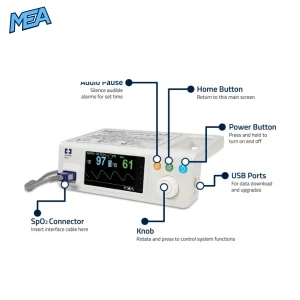
Easy-to-Use Jog Dial Control
The intuitive jog dial allows clinicians to:
- Navigate settings quickly
- Access patient information
- Configure alarms
- Review monitoring data
- Adjust operating parameters
Clear Clinical Display
The monitor provides immediate access to:
- SpO₂ readings
- Pulse rate values
- Plethysmographic waveform
- Pulse amplitude information
- Alarm status indicators
The display is designed for fast interpretation in busy healthcare environments.
Continuous Monitoring and Trend Analysis
Real-Time Monitoring
The PM100N continuously displays:
- Oxygen saturation (SpO₂)
- Pulse rate
- Pulse amplitude
- Pleth waveform
These measurements support informed clinical decision-making.
96-Hour Trend Memory
Long-term patient monitoring requires reliable data storage.
The PM100N includes:
- Up to 96 hours of trend data
- Historical review capability
- Patient progress tracking
- Clinical documentation support
Trend data can assist clinicians in evaluating patient status over time.
Compact, Portable, and Durable Design
Healthcare facilities often require monitoring equipment that can move easily between departments and patient locations.
Portability Features
- Integrated carrying handle
- Lightweight construction
- Compact footprint
- Durable housing
- Flexible placement options
The monitor weighs only 1.36 kg, making transportation and deployment simple.
Connectivity and Data Export Capabilities
Clinical Data Management
The PM100N supports trend data export for:
- Medical record documentation
- Clinical review
- Data archiving
- Research applications
- Patient outcome analysis
Connectivity Options
- USB data export
- Wired data transfer
- External computer integration
- Trend analysis support
These features help streamline patient record management.
Applications of the Nellcor PM100N Patient Monitoring System
The monitor is suitable for numerous healthcare applications.
Hospital Patient Monitoring
- General wards
- Recovery rooms
- Intensive care units
- Emergency departments
- Post-operative monitoring
Home Healthcare
- Chronic respiratory disease monitoring
- Long-term oxygen therapy patients
- Home caregiver supervision
- Post-discharge monitoring
Sleep Medicine
- Sleep studies
- Overnight oximetry
- Respiratory disorder assessment
- Sleep laboratory monitoring
Neonatal Monitoring
- Newborn oxygen monitoring
- NICU applications
- Pediatric respiratory assessment
Technical Specifications
| Specification | Details |
| Product Name | Medtronic Nellcor PM100N Bedside SpO₂ Patient Monitoring System |
| Technology | OxiMax™ Pulse Oximetry |
| Monitoring Parameters | SpO₂, Pulse Rate, Pulse Amplitude |
| SpO₂ Range | 1% to 100% |
| Pulse Rate Range | 20 to 250 bpm |
| Pulse Amplitude Range | 0.03% to 20% |
| Adult Accuracy | 70%-100% ±2 digits |
| Neonate Accuracy | 70%-100% ±2 digits |
| Motion Accuracy | 70%-100% ±4 digits |
| Low Perfusion Accuracy | 70%-100% ±2 digits |
| Trend Memory | 96 Hours |
| Alarm System | SatSeconds™ Alarm Management |
| Connectivity | USB and Wired Data Export |
| Operating Modes | Standard, Homecare, Sleep Study |
| Power Supply | 100–240 VAC, 50/60 Hz |
| Battery Type | Lithium-Ion |
| Battery Runtime | Minimum 5 Hours |
| Weight | 1.36 kg |
| Width | 10.04 in |
| Height | 3.23 in |
| Depth | 6.10 in |
| Operating Temperature | 5°C to 40°C |
| Humidity | 15% to 93% Non-Condensing |
| Altitude Range | -170 m to 4877 m |
| Nurse Call Capability | Yes |
| Dimensions | Width: 10.04″ | |
| Height: 3.23″ | ||
| Depth: 6.10″ | ||
| Weight | 1.36kg | |
| Performance | Measurement Range: SpO2 : 1% to 100% | |
| Pulse Rate: 20 to 250 beats per minute (bpm) | ||
| Pulse Amplitude: 0.03% to 20% | ||
| Measurement Accuracy | ||
| Saturation | Adult: 70% to 100% ± 2 digits | |
| Adult and Neonate Low Sat: 60% to 80% ± 3 digits | ||
| Neonate: 70% to 100% ± 2 digits | ||
| Low Perfusion: 70% to 100% ± 2 digits | ||
| Adult and Neonate with Motion: 70% to 100% ± 4 digits | ||
| Pulse Rate | Adult and Neonate: 20 to 250 bpm ± 3 digits | |
| Low Perfusion: 20 to 250 bpm ± 3 digits | ||
| Adult and Neonate with Motion: 20 to 250 bpm ± 5 digits | ||
| Electrical | ||
| Instrument Power Requirements | 100 to 240 VAC, 50/60 Hz, 45 VA | |
| Fuse Rating | Fast acting: 2 A 32VAC/DC | |
| Fast acting 500 mA 32VAC/50DC | ||
| Battery | Type: Lithium Ion | |
| Battery Capacity: Minimum of five hours using new, fully charged battery with no alarms | ||
| Environmental | ||
| Operating Temperature | Instrument 5 °C to 40 °C (41 °F to 104 °F) | |
| Transport/Storage Temperature (in shipping carton): -20 °C to 60 °C (-4 °F to 140 °F) | ||
| Operating Humidity: 15% to 93% non condensing | ||
| Operating Altitude: -170 m to 4877 m (-557 ft to 16,000 ft) | ||
| Output | Trend data download via wired or USB for archiving or data analysis | |
| Display/Indicators | Pulse amplitude indicator (eight segments) | |
| Visual indicators: Pulse search, audible alarms silenced or off, interference indicator, battery charging, and SatSeconds alarm management clock, pleth wave form | ||
| Alarms | SatSeconds alarm management | |
| Audible and Visual alarms for high/low saturation and pulse rate, low battery, sensor off, and sensor disconnect | ||
| Categories: Patient status and system status | ||
| Priorities: Low, medium and high | ||
| Notification: Audible and visual | ||
| Setting: Default, institutional and last setting | ||
| Alarm system delay: <10s | ||
| Available Modes | Standard – Hospital, hospital type facilities, and intra hospital transport | |
| Homecare – Simplified monitoring for use in the home by caregivers | ||
| Sleep Study – Muted audible and visual queues to aid sleep studies | ||
| Connectivity | Supports wired and USB trend data export to an external personal computer for archiving or data analysis | |
| Nurse call capability |
Frequently Asked Questions
What does the Nellcor PM100N monitor measure?
The PM100N continuously measures oxygen saturation (SpO₂), pulse rate, and pulse amplitude while displaying plethysmographic waveforms.
Is the PM100N suitable for home healthcare use?
Yes. The device includes Homecare Mode and complies with IEC 60601-1-11 standards for home healthcare environments.
Can the monitor be used for neonatal patients?
Yes. The monitor supports adult, pediatric, and neonatal patient monitoring modes.
What is SatSeconds™ alarm management?
SatSeconds™ is a clinician-controlled alarm feature that evaluates both the severity and duration of oxygen desaturation events to reduce nuisance alarms.
Does the monitor work during patient movement?
Yes.
How much trend data can be stored?
The monitor can store up to 96 hours of trend data for patient review and analysis.
Can data be exported from the monitor?
Yes. Trend data can be exported via USB or wired connection for archiving and clinical analysis.
How long does the battery last?
The lithium-ion battery provides a minimum of five hours of operation when fully charged.
Is the monitor suitable for sleep studies?
Yes. The dedicated Sleep Study Mode dims the display and silences alarms to minimise patient disturbance.
What healthcare settings can use the PM100N?
The monitor is ideal for hospitals, clinics, emergency departments, sleep laboratories, homecare environments, long-term care facilities, and patient transport applications.
Order the Medtronic Nellcor PM100N Bedside SpO₂ Patient Monitoring System
The Medtronic Nellcor PM100N Bedside SpO₂ Patient Monitoring System delivers advanced pulse oximetry monitoring, intelligent alarm management, motion-tolerant performance, and flexible operating modes for modern healthcare environments.
With OxiMax™ technology, comprehensive trend analysis, and support for adult, pediatric, and neonatal patients, it provides clinicians with reliable monitoring capabilities across hospital, homecare, and sleep study applications.


Reviews
There are no reviews yet.